

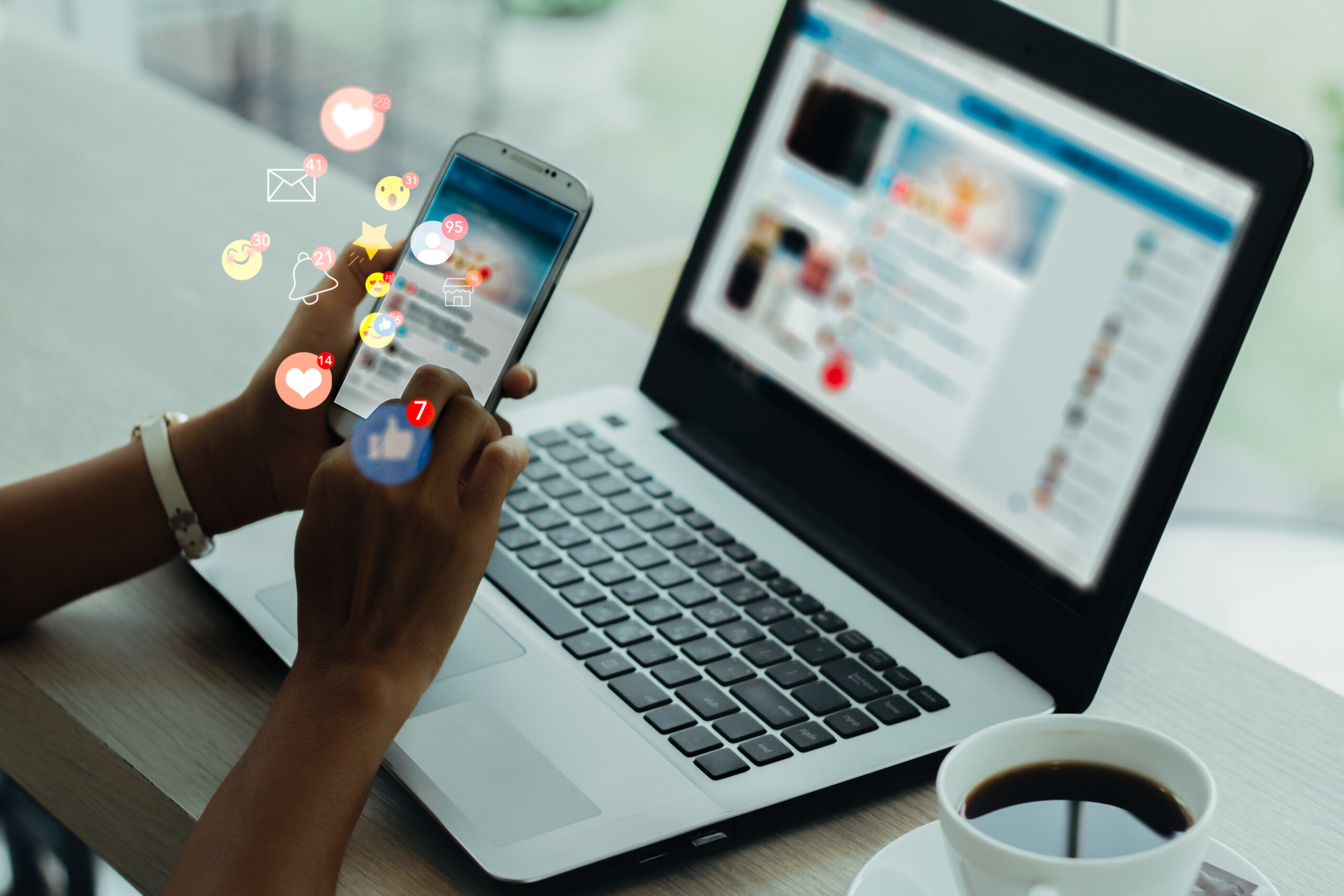
Nowadays, when businesses take their first steps online, the obvious go-to is to create a social media account. With over 5.6 billion active users worldwide (source: We Are Social / Meltwater), these platforms have become an unquestionable starting point for any online presence. An Instagram or LinkedIn profile, a Facebook page… all it takes is a few clicks: simply upload a few photos and your business has already established a basic online presence.
A website, however, can require greater consideration before taking the leap. Is it really necessary? Are social media accounts sufficient? How do you know how to go about it? All common questions that small businesses and self-employed professionals ask.
It’s normal to have doubts, but these can be quickly swept aside once people realise why a website is, in fact, essential. While social media may be a formidable tool that uses virality to raise account profiles, it does not serve quite the same purpose. Which is why the two are complementary.
Social media: where you get noticed
Let’s take an example. The Brigat bakery/pastry store in Paris regularly publishes photos of their creations on Instagram. Crispy bread rolls, flaky-pastry brioches, creamy ice creams. Their followers, for the most part local residents, comment, share and send the posts to their friends. At lunchtime, people come to the store saying: “We saw your grapefruit tart on Instagram”. Mission accomplished.
Social media excels at that sort of publicity: giving a behind-the-scenes look at everyday life, creating connections, and making people want to try for themselves. It’s a bit like an animated window display, accessible from anywhere, and constantly changing. And that doesn’t just apply to pastries! All types of businesses can reap the benefits. You can showcase an ongoing project, a photo shoot session, the arrival of a new product, or the preparations ahead of an event. Which is precisely why many businesses use social media to develop their image and engage with their customers.
But this window display has one flaw: it is somewhat chaotic. Someone coming across the Brigat bakery/pastry store for the first time and wanting to find out information about its opening hours, how to get there or detailed prices, the terms and condition of sale or orders, or a list of allergens, will need to scroll through dozens of publications to find them. And in many cases, they’ll come up empty handed.
Websites: where everything is clear and structured
This is where a website comes into its own. A website is your very own space: structured, stable, with an address your customers can easily find and where you offer more than just a simple window display, where you take the time to explain what you do, how it works, and how customers can order.
Let’s go back to the example of Brigat. Visitors to its website https://brigat.paris can learn about the house specialities, how to order a customised cake, where the store is located, and how to contact the team all in just a matter of seconds. Everything is structured and legible, and above all, in the same place. While social media attract, a website clarifies and reassures. It allows you to present your activity logically and in detail. Which is what makes the difference when it comes to converting curiosity into action: an interested visitor becomes a customer who calls, makes a reservation, or requests a quotation.
In practice, that’s how the customer journey tends to play out: potential customers come across a business on social media then search for their website a few minutes later to check the information, see what services are offered or simply find out who’s behind the company. A well-constructed website thus helps strengthen confidence and projects a more professional image, in order to reassure visitors and improve conversion rates.
The problem of relying solely on social media
Another less well-known reality is that on social media, you are always dependent on a third party. Your visibility depends on an algorithm that is not within your control and which decides which publications appear on users’ feeds. One day they’re seen by large numbers of users. The next, by just a handful.
And the rules change regularly. The natural reach of businesses’ publications can vary significantly, even over short periods. On Facebook, for example, studies have shown that organic reach fluctuates considerably from one month to another: without paid advertising, a publication can reach just 1% of a page’s followers at times, and up to 6% at others (source: SocialStatus). In other words, even the people who follow your page do not necessarily see your content.
Social media is also saturated with publications. Millions of new content, photos, videos and messages battle it out every day to draw attention. The result: a publication has a lifespan of just a few days, or even a few hours, before disappearing under the weight of the many others.
Why the two work better together
So does that mean that you need to choose between social media and a website? As it turns out, no. The two actually complement rather than contradict each other. Social media allows you to capture attention and inspire, whereas a website provides an independent space to present your activity in greater detail and enable visitors to take the next step.
An interior designer can publish photos of a recently renovated apartment on Instagram, for example, to illustrate their style and allow viewers to imagine a remodel for themselves, as well as attracting attention. And the description can include a link redirecting to their website where visitors can find details of the services offered, other real-life examples, customer testimonials, a form to request an initial meeting, etc. In this case, Instagram acts as a gateway to discovering the designer’s work, while the website paves the way for the next step: confirming the visitor’s interest, offering further information on the services provided, and allowing them to get in touch or request a quotation.
What if I don’t know how to build a website?
It’s a question many businesses ask in the beginning: do I need to know how to code? Understand the technical aspects? Or how to manage a complex project?
In reality, creating a website is now much easier than it was even just a few years ago. A wide array of tools, such as WIX, WordPress and IONOS, provide ready-to-use templates that allow you to create a showcase website or e-commerce site including a few basic pages presenting your activity, your services and your contact details, without the need for any specific technical know-how.
Some platforms go even further and offer website creation tools based on artificial intelligence (AI). Once you’ve input a few details about your activity, starting with your business name, your sector and a short description of what you do, the AI technology automatically generates a draft version of the website with a page structure, texts and images that you can subsequently alter.
And of course, you can always rely on the help of professionals – whether an agency, freelance or developer – to design a more customised website or simply to help you get started.
An address to represent you online
It all boils down to one simple question: which address should you use for your website? A domain name is often the first thing customers keep in mind. It’s the address you give out, that users enter into their browser, and that allows them to easily find your website.
For businesses established in the capital, this address can even provide a clear geographic reference under a .paris TLD, instantly positioning the company’s activity within the region. A .paris is also an excellent means of showcasing your identity, in a European capital that embodies the know-how, creative energy and high standards and values that many companies hold true.
A .paris TLD is also a great way to boost online visibility for businesses in the capital. And it can consolidate a website’s geographic coherency and its relevance for search engines when it comes to local searches (in cases where Internet users include a “near me” factor or a specific arrondissement, for example). This also helps improve search result positioning.
When it comes down to basics, an online presence is much like having a physical store. Social media can also play a storefront role: it attracts attention, spurs visitors to action, and showcases the brand’s universe. A website, meanwhile, is an embodiment of the store itself, where visitors can explore the business’s offering in detail before taking the next step. A clear and easily identifiable address, under a .paris TLD, for example, is a simple way to help customers find the business they’re looking for close to them.